Conflict in Afghanistan
/ 4 min read
1. US Airstrikes
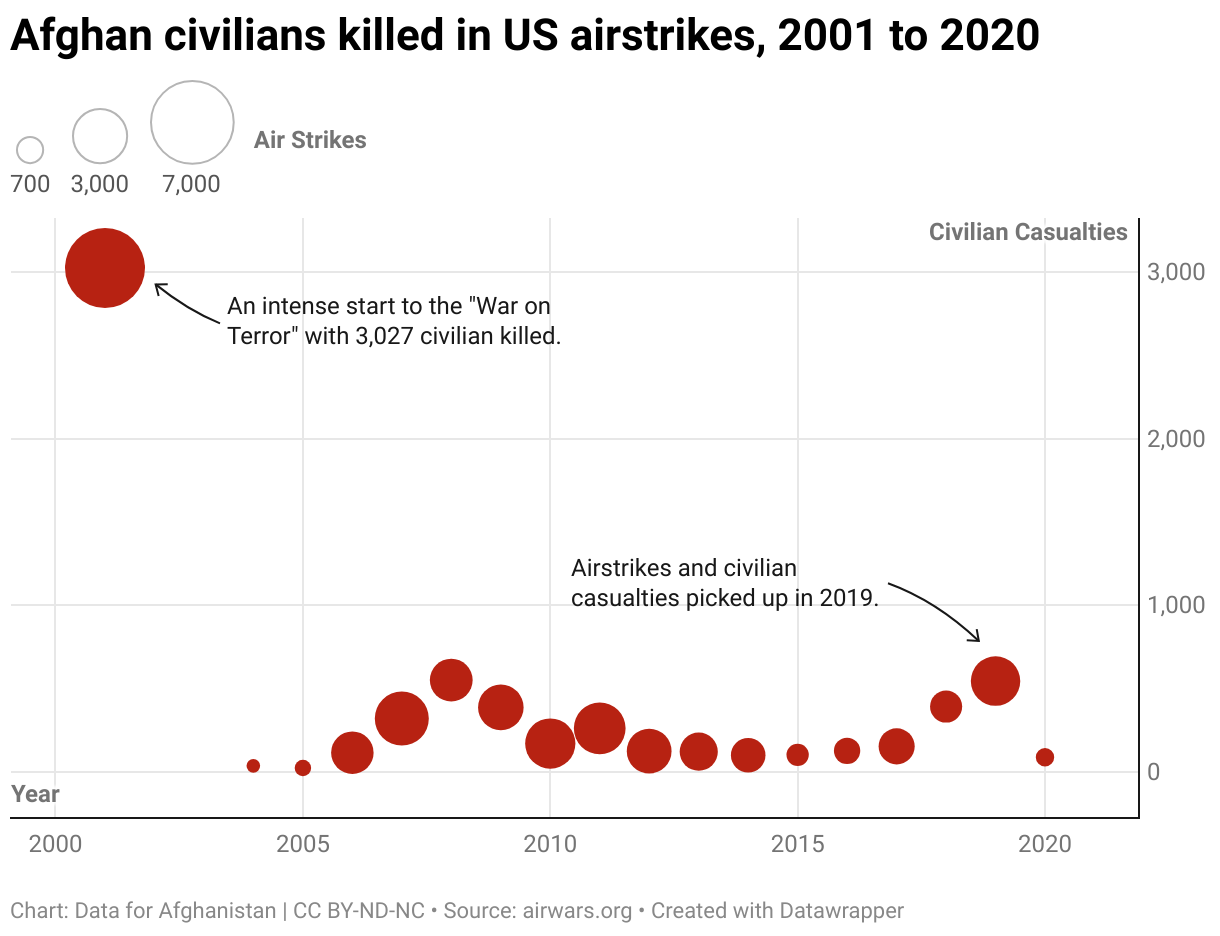
- US airstrikes and associated civilian deaths were alarmingly high in 2001, with 6,546 strikes and 3,027 civilian deaths. Although airstrikes significantly decreased to just 247 in 2020, sporadic spikes in civilian casualties — such as 552 in 2008 and 546 in 2019 — underscore the persistent and devastating impact on civilian lives.
- Despite an overall reduction in air strikes, civilian casualties did not always follow the same downward trend. For instance, 2019 saw over 2,400 airstrikes causing 546 civilian deaths, highlighting the continued vulnerability of civilians in Afghanistan.
Cite this work:
Data for Afghanistan. (2024). Afghan civilians killed in US airstrikes, 2001 to 2020 [Data visualization]. https://dataforafghanistan.org/posts/conflict/#1-us-airstrikes Licensed under CC BY-ND-NC 4.0.
2. Opium Cultivation

- Opium cultivation over 1994–2025 is extremely concentrated in a small number of provinces. Hilmand alone accounts for a dominant share of total cultivated area, followed by Kandahar, Nangarhar, Farah, and Uruzgan. Together, these provinces form a clear cultivation belt in the south and east, while many central and northern provinces—such as Panjsher, Paktika, Logar, and Bamyan—record negligible or near-zero cumulative cultivation.
- The strong geographic concentration of opium cultivation points to deep structural drivers, i.e, agro-climatic suitability, irrigation access, insecurity, and limited licit livelihood options, rather than a nationwide phenomenon. Policy responses aimed at reducing cultivation are therefore unlikely to succeed if applied uniformly; instead, they require place-based strategies that combine rural development, water management, market access, and security interventions in high-cultivation provinces, alongside prevention and monitoring in low-cultivation areas.
Cite this work:
Data for Afghanistan. (2026). Cumulative opium cultivation in Afghanistan, 1994–2025 [Data visualization]. https://dataforafghanistan.org/posts/conflict/#2-opium-cultivation. Licensed under CC BY-ND-NC 4.0.

- Panel data for the top opium-cultivating provinces show strong persistence but also sharp temporal volatility. Hilmand consistently dominates cultivation and drives national totals, especially during major expansion phases in the mid-2000s and post-2013, closely mirroring spikes in Afghanistan’s total cultivated area. Nangarhar and Kandahar exhibit pronounced boom-and-bust cycles, including near-zero cultivation in some years, while Uruzgan and Farah contribute smaller but recurrent shares, reinforcing the role of a core group of provinces in shaping national trends.
- The tight co-movement between opium cultivation in a handful of provinces and Afghanistan’s national totals implies that nationwide fluctuations are largely the result of localized dynamics. This underscores the importance of province-specific shocks, such as policy enforcement, conflict intensity, climate variability, and market access, in explaining year-to-year variation. For analysis and policy, panel data highlight that sustainable reductions in nationwide opium cultivation depend disproportionately on interventions in a small set of provinces, particularly Hilmand, rather than diffuse, nationwide approaches.
Cite this work:
Data for Afghanistan. (2026). Opium cultivation (hectares) in the five provinces with the largest cumulative cultivated area over 1994–2025 [Data visualization]. https://dataforafghanistan.org/posts/conflict/#2-opium-cultivation. Licensed under CC BY-ND-NC 4.0.
3. Terrorism

- Terrorist violence was highly concentrated geographically in Afghanistan during 2001-2020 period. Kandahar, Helmand, Kabul, Nangarhar, and Ghazni together account for a large share of both incidents and casualties. In contrast, provinces such as Panjsher, Bamyan, Daykundi, and Nuristan experienced relatively few incidents and casualties, pointing to stark regional disparities in exposure to violence.
- The uneven distribution of incidents and casualties suggests that conflict dynamics in Afghanistan were driven by strategic, political, and logistical factors concentrated in specific provinces along the southern and eastern border. This has important implications for post-conflict recovery and policy, i.e., security, humanitarian assistance, and development efforts need to be spatially targeted, with sustained attention to high-burden provinces and protecting the gains of low-incident provinces.
Cite this work:
Data for Afghanistan. (2026). Terrorism incidents & casualties in Afghanistan, 2001-2020 [Data visualization]. https://dataforafghanistan.org/posts/conflict/#3-terrorism. Licensed under CC BY-ND-NC 4.0.